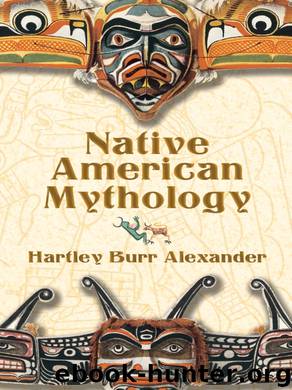
Native American Mythology by Hartley Burr Alexander
Author:Hartley Burr Alexander
Language: eng
Format: epub
ISBN: 9780486122793
Publisher: Dover Publications
Published: 2012-10-11T16:00:00+00:00
IV. NAVAHO RITUAL MYTHS5
The myth of the creation of the sun, just quoted, gives a vivid picture of a primitive ritual, with its reliance upon mimetic magic and the power of suggestion; the magic depicted is that of the gods, but all Navaho ceremonials, and indeed Indian rituals generally, are regarded as derived from the great powers. The usual form of transmission is through some prophet or seer who has visited the abodes of the powers, and there has been permitted to observe the rites by means of which the divine ones attain their ends. On returning to his people, the prophet brings the ceremony (or “dance,” as such rites are frequently called, although dancing is commonly a minor feature) to his people, where it is transmitted from generation to generation of priests or shamans. It is interesting to note that among the Navaho it is usually the younger brother of the prophet, not the prophet himself, who conducts the rite, when once it is learned;44 and it is their custom to choose younger brothers to be educated as shamans (though the elder brothers are not deterred from such a career, if they so choose) the Navaho reason being that the younger brother is likely to be the more intelligent.
Indian rites may be broadly divided into three classes: (1) rites pertaining to the life-history of the individual — birth, pubescence, death; and to social life — clan and fraternity rites, rites for the making of war and the cementing of peace; (2) rites connected with the elements and seasons, maize festivals, rain dances, the magic fructification of fields and the magic invocation of game; and (3) mysteries or medicine rites, designed to bring health, both physical and spiritual, and to ensure life and prosperity to individual and tribe, — a therapeutic which recognizes that all men are at all times ailing and in need of some form of divine aid. The various elements of the different types interlace, but in general, those of the first class fall into a biographical or an historical series, those of the second class tend to assume a ferial character, and those of the third class depend upon the chance of necessity or of desire for their performance — upon the fulfilment of a vow, the need of the sick for cure, or the like.
Navaho ceremonials are mainly of the latter kind and are in sharp contrast to the calendric rites of their Pueblo neighbours. They are medicine ceremonies, undertaken in the interest of the sick, who individually defray the expenses, although the rite is supposed to benefit the whole tribe; and they are performed at no stated times, but only in response to need. There is, however, some restriction: the Night Chant, the most popular of all Navaho ceremonies, may be held only in the winter, when the snakes are hibernating — perhaps because serpents are regarded as underworld-powers, and related to the maleficent deities of the region of the dead; a similar motive
Download
This site does not store any files on its server. We only index and link to content provided by other sites. Please contact the content providers to delete copyright contents if any and email us, we'll remove relevant links or contents immediately.
| Anthropology | Archaeology |
| Philosophy | Politics & Government |
| Social Sciences | Sociology |
| Women's Studies |
Cecilia; Or, Memoirs of an Heiress — Volume 1 by Fanny Burney(32558)
The Great Music City by Andrea Baker(32018)
Cecilia; Or, Memoirs of an Heiress — Volume 2 by Fanny Burney(31956)
Cecilia; Or, Memoirs of an Heiress — Volume 3 by Fanny Burney(31941)
We're Going to Need More Wine by Gabrielle Union(19046)
All the Missing Girls by Megan Miranda(16026)
Pimp by Iceberg Slim(14506)
For the Love of Europe by Rick Steves(14121)
Bombshells: Glamour Girls of a Lifetime by Sullivan Steve(14075)
Talking to Strangers by Malcolm Gladwell(13370)
Norse Mythology by Gaiman Neil(13363)
Fifty Shades Freed by E L James(13240)
Mindhunter: Inside the FBI's Elite Serial Crime Unit by John E. Douglas & Mark Olshaker(9342)
Crazy Rich Asians by Kevin Kwan(9292)
The Lost Art of Listening by Michael P. Nichols(7506)
Enlightenment Now: The Case for Reason, Science, Humanism, and Progress by Steven Pinker(7313)
The Four Agreements by Don Miguel Ruiz(6765)
Bad Blood by John Carreyrou(6621)
Weapons of Math Destruction by Cathy O'Neil(6279)
